Monday, October 1, 2007

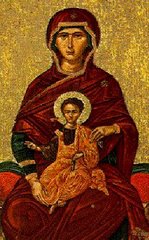
St. Jerome (September 30)

Though his feast fell on a Sunday, and so it was not celebrated externally, yesterday was still the feast of St. Jerome, one of the great Fathers of the Church, credited with translating scripture into Latin so as to make it available to the western world where Greek had fallen out of use.

"Ignorance of Scripture is ignorance of Christ." - St. Jerome


"Those who do not read have no advantage over those who cannot read." S. L. Clemens (Mark Twain)
Tolle, legge,
Mr. B

Wednesday, September 26, 2007

Additional Questions

These questions cover pages 56 - 63, but the answers are not the type you can look up and copy; You have to form them yourself. Write or type the answers and bring them to class next time.

A. Compare and contrast Survival Rights and Thrival Rights. Don't just copy the definition from the book;Explain how they are similiar and how they differ by nature.

B. It would be easy to assume that the concept of the "common good" would simply be the "most good for the most people". Explain how, in a society in which people have different attitudes, opinions, and expectations, you can establish a common good "for all people".

C. Refute the argument that in order for some to participate and be successful in society there must be some who are marginalized. (In other words, there cannot be winners unless there are losers.)

Ad Jesum per Mariam,
Mr. B

Tuesday, September 25, 2007

The Seven Themes of Catholic Social Teaching

We are in the midst of our study of the development of modern injustices. When we complete that unit we will begin looking at how the Church directs us to respond to those injustices, which is called Catholic Social Teaching (hence the name of the class).

Catholic Social Teaching addresses seven key themes, which can be found in the chart on page 56 of your textbook. There is also a short explanation of them found at this link. We will go into detail about them later, but I wanted to bring your attention to them as they will be central in the theological content of your senior project.

Next up, we will study Nationalism, Rationalism, & Colonialism.

Ad Jesum per Mariam,
Mr. B

Sunday, September 23, 2007

Feudalism

To study our first "-ism" we take a large step back into history and look at the Middle Ages.

Feudalism was he social, political, and economic structure of society in the Midle Ages. It was characterized by a clear caste system which created many distinct layers within society.

The members of the upper levels of society believed that the hierarchical stratification of society reflected God's divine plan for all of Creation. That is to say, they believed that God wanted the kings to be kings, the lords to be lords, and the peasants to be peasants. There was virtually no Upward Mobility (raising one's self to a higher social & economic class) in the middle ages. Kings ruled by Divine Right (the idea the their authority lay in the fact that God willed them and their descendants to be the leaders.

The Middle Ages consist of roughly the Millenium between the fall of the Roman Empire (476 A.D.) and the tumultuous 15th Century. (Basically from 500 - 1500 A.D.)

The Geographical context of feudalism was essential all of Western Europe, though it was concentrated in the areas that are today known as France, Germany, Great Britain, Italy, and Spain.

The economy was a land-based one, meaning that the truest measure of one's wealth was in the farmable land that he owned or controlled. To help manage the large areas of land, a region would be broken up into fiefdoms - smaller regions placed in control of a vassal (a lesser nobleman such as a duke or lord). In exchange for the land, the vassal would provide his lord with money, crops, and with the support of his own army when called upon. This fiefdom would in turn be broken up into smaller segments and farmed by the serfs or peasants who inhabited the land.


The peasants led a rather bleak life. The life expectancy was hardly into one's 40's. To reach a 50th birthday was a feat. Peasant homes were generally thatched roof cottages with dirt floors. Their diet was largely grain-based with little in the way of fresh fruits, vegetables, or meat.
Most of the produce they grew was for their land lord, and little if any of it made its way to their own tables. The labor of farming was back-breaking and the work day as long as the daylight. Clothing was homespun cloth which offered little protection against the elements, and even less comfort.

Meanwhile the land owners lived in relative luxury: stone manors (castles were primarily military fortifications rather than private homes), a diverse and hearty diet, clothing of fur and fine coth, and abundant time for leisure and entertainment.
The preservation of wealth and power from one generation to the next was of great importance to medieval leaders. This led to a policy of primogeniture, where the oldest male heir inherits virtually all of the land, wealth, and authority of his father. (The alternative, equally distributing the land among one's children, would quickly lead to the diminishment of wealth and power as each succeeding generation controlled less and less land.)

The downside of primogeniture is that it left the younger sons often in a difficult position. They could opt to "play second fiddle" to an older brother, to seek their own power through marriage and military conquest, or to become authorities in their own right through a career in the Church. It was this last option that led to some of the darkest pages in the Church's history.

Often the younger sons of the nobility would be put on the path to a career in the Church from a very young age. A man would make a large donation in gold (or more likely, land) to a local monastery, and in turn, drop off his son to be education by the monks. Monasteries were the centers of learning in the middle ages, and they preserved much of the literary heritage of the ancient world by the copying and studying of manuscripts. (see Thomas Cahill's popular book, How the Irish Saved Civilization, for an account of the debt owed to medieval monks.) Until the rise of cathedral schools in the late middle ages, monasteries were the only educational option aside from having a private tutor.

Sadly, many of the young men who were products of the monastic education system entered into careers in the Church not out of a sense of Divine calling or obedience to the will of God and service to His Church, but rather out of a desire to retain a position of power and relative wealth and luxury.

Due to a controversy known as lay investiture (where secular rulers apointed many ecclesial leaders) and corrupt practices like simony and nepotism, the ranks of the bishops was at times less than holy. Simony is the practice of "buying" or bribing one's way into office. Nepotism, on the other hand, is being appointed to a position of power and authority based only on one's personal and social connections and without any concern given to one's ability or qualifications.

I shall beef this post up a little more soon with some names and photos. Until next time,
AJPM,
Mr. B

Wednesday, September 19, 2007

You will always have the poor...

We discussed the Gospel passage in which Jesus tells us that we will always have the poor in our midst. This does not mean we should stop trying to relieve the struggle of those in poverty, but rather recognize that our time and efforts should be direct at BOTH God and Neighbor, and not just the latter.


I mentioned that this passage is often used to underscore the argument that Churches should have "nice" things to be used in worship (vestments, vessels, and so forth). This prompted some heated debate, for which I am very grateful.


I pointed out, God does not need all of this finery. Rather, as weak-minded mortals, we humans need these objects to signify the reverence we should give to the mysteries of our faith and to help direct our wandering minds away from the worldly and toward the spiritual.

A student pointed out that in the movie Indiana Jones (respected source of authority that it is) the Holy Grail was not a super-bling goblet, but was a simple cup. However, it is worthy of note that the interior of the cup was in fact Gold. We offer to God our very best, especially when it comes to the celebration of the sacrament of our salvation, the Holy Sacrifice of the Mass. These items are not for the luxury of the priest or the adornment of the Church, but for the reverent worship of God in heaven. (however, anyone can go overboard, and you are right to be cautious where such material things are concerned. As the venerable Mr. Pfennig says, "all things in moderation...including moderation."

Well, get crackin' on your papers. until next time,

Ad Jesum Per Mariam,
Mr. B.

"Ism" Projects

Your "-ism" paper is to be two pages in length and you are not to use the internet for your research. Rather, explore the wealth of knowledge found in BOOKS. Make sure that you cover the answers to the following questions:

1. Clearly define the –ism
2. Place the –ism in its historical context: When did it arise and become prominent?
3. Place the –ism in its geographical context: Where was it prominent?
4. What problem or social issue was the –ism intended to rectify?
5. Who were the founders, leaders, or advocates of the –ism?
6. What were the benefits of the –ism? (For individuals, classes, or society at large)
7. What were the downsides of the –ism? (For individuals, classes, or society at large)
8. What problems or social issues did it cause?
9. How did the Church react to the –ism? Why?
10. Who were notable opponents to the school of thought in question?
11. Name any non-traditional sources that are influenced by or depict the school of thought. (Movies, music, art, literature, etc.)

In addition to the paper, students will be responsible for teaching the school of thought to the class. The lesson should highlight the main points of the ideology, using the questions above as reference points. Students are encouraged to utilize audio or visual aids in the lesson, including posters, brief audio or video clips, or power point presentations. Handouts are also helpful, but not required. Finally, the lesson should include two or three discussion questions for the class.

If you need copies of handouts or any other arrangements for your lesson, let me know as soon as possible to ensure that your presentation is a success.


"A person should not believe in an -ism; He should believe in himself." -Ferris Bueller.

Tuesday, September 18, 2007

Social History of Injustice

Before we study the Church's approach to fixing our broken world, we will examine how it came to be as broken as it is. We will examine these eight political, economic, and philosophical ideas and how they led to injustice in our world.

(Please note that most of these ideas are not in themselves injust, but rather gave rise to injustice as they were practiced and applied.)

1. Feudalism - the layered class structure of medieval society. (image: Crowning of Charlemagne)


2. Nationalism - an intense sense of patriotism and superiority


3. Rationalism - the idea that logic & reason are the sole source of authority in all human endeavors. (images: Rene Descartes & Baruch Spinoza)

4. Colonialism- when one nation extends its reign to other regions and subjects the indigineous (native) people to second class status. (image: Columbus "discovers" America.)


5. Industrialism - the shift from an agrarian (agricultural) economy to a factory-based economy


6. Captialism - the economy is controlled by investors of capital and the trends of consumer activity.


7. Communism - the economy is controlled by the workers, usually through a centralized government.


8. Fascism - a political system typically ruled by a militant dictator. The rights of the state are always superior to those of its citizens.


Please research your given topic - remember, all the books you want, but no internet.


Ad Jesum Per Mariam,

Mr. B.